Matte White Polypropylene Inkjet Labels for Roll Printing
30th Oct 2026
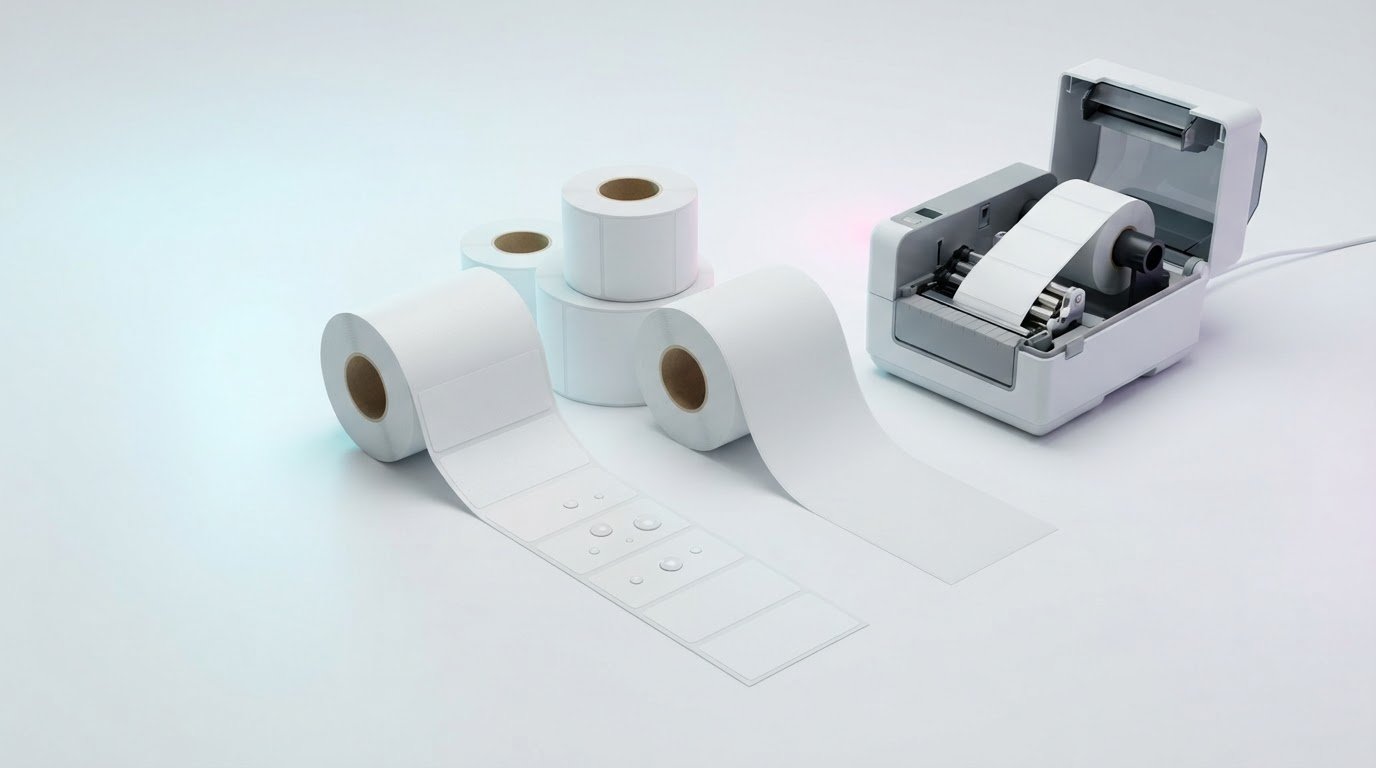
A matte finish is only part of the decision: matte white polypropylene inkjet label rolls also vary by thickness, roll fit and label format. Matte white PP facestock is commonly available in thicknesses from 50 to 100 microns, with 60-80 microns common for general-purpose applications; quality films typically have 90-95% opacity. Polypropylene doesn’t absorb water, which helps the face stock and adhesive stay intact when wet.
Choosing a roll that fits your printer and production needs is as important as selecting the material. Core size and outside diameter affect printer compatibility, while label shape, dimensions and roll length determine how well the format suits your product and workflow.
This guide explains matte white polypropylene, how core size and outside diameter differ, and when to choose die-cut or continuous formats. It also compares matte BOPP inkjet labels to help you select a practical option for your printer and application.
Key Takeaways
- Compare face-stock thickness, opacity, adhesive and liner to choose a material that suits your product and application.
- Match the roll’s core and outside diameter to your printer specifications, such as compact desktop models that use a 2-inch core and 4-inch outside diameter.
- Choose between die-cut shapes and continuous rolls based on your label dimensions and production workflow.
- Review matte white polypropylene inkjet label rolls by label size, roll length and quantity to find a practical fit for your printing needs.
- For colour label printing, compare digital colour press models by print speed, ink type and whether you need an internal or external unwinder.
What Is Matte White PP Label Material?
Matte white polypropylene, or PP, is a synthetic film facestock with a non-gloss surface for inkjet printing. Unlike paper, polypropylene does not absorb water, helping the facestock and adhesive stay intact when wet. The matte finish also accepts permanent-marker notation, which is useful when a package needs a handwritten detail alongside its printed design.
Thickness and opacity help define the material. Matte white PP facestock is commonly available from 50 to 100 microns thick, with 60-80 microns common for general-purpose applications. Quality films typically have 90-95% opacity, so the white surface provides a solid background for printed text and colour. One listed material is 100 microns thick, with acrylic adhesive and an 80-g glassine liner.
Available dimensions affect both label fit and the quantity per roll. Examples include:
- A 2-inch by 1-inch roll listing has 900 labels per roll; a separate BOPP format listing has 1,100.
- A 2-inch by 2-inch roll has 500 labels per roll.
- A 4-inch by 2.5-inch roll has 400 labels per roll; a 4-inch by 3-inch roll has 350.
- A 4-inch by 4-inch roll has 250 labels per roll, while a 4-inch by 6-inch roll has 150.
- A 3-inch by 5-inch roll has 200 labels per roll.
Quantities can differ between listings and formats, so compare the exact dimensions and product construction. A 2-inch by 6-inch BOPP format is supplied as 12 rolls per case, totalling 2,400 labels. That works out to 200 labels per roll, useful for planning replenishment and case quantities.
To compare prices, divide the quoted roll price by its label count, or divide the case price by the total number of labels. A case and a single roll contain different quantities, so compare unit costs against expected usage. Prices vary by size and packaging format.
Release force matters when a roll feeds through an applicator. Matte white PP stock suppliers typically provide release-force data of 5-15 cN/cm for each product grade. Use that figure alongside the applicator’s feed requirements to assess whether the label releases cleanly from its liner.
Compared with paper, PP is a synthetic, water-resistant facestock; its matte surface looks different from the reflective finish of glossy synthetic labels. Canadian labelling requirements depend on the product category and the information presented, so separate content requirements from the material’s physical suitability. Custom dimensions, adhesive and winding affect printer and applicator fit, so include them in your selection.
For inkjet printing, compare material dimensions, roll quantity and liner details together; inkjet label formats show how these specifications relate to roll use.
Roll core and outside diameter options
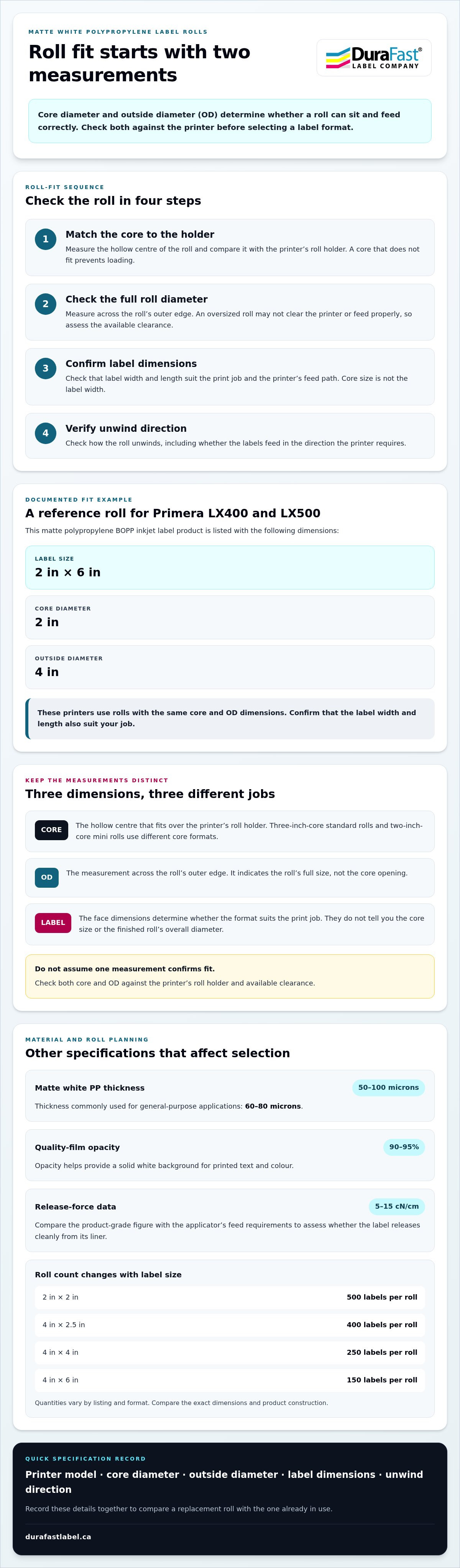
Core diameter and roll outside diameter determine whether a roll can sit and feed correctly in a printer. The core is the hollow centre that fits over the holder; outside diameter, or OD, measures across the roll’s outer edge. Both measurements matter. A core that does not fit the holder prevents loading, while an oversized roll may not clear the printer or feed properly.
For a documented example, a 2-inch-wide by 6-inch-long matte polypropylene BOPP inkjet label product has a 2-inch core and a 4-inch outside diameter. Primera LX400 and LX500 printers use matte polypropylene inkjet rolls with those same core and OD dimensions. This provides a useful reference when comparing a roll to either printer, but label width and length still need to match the job.
Three-inch-core standard rolls and two-inch-core mini rolls use different core formats. Core size is not the label width, and it does not indicate the finished roll’s overall size. A three-inch core has a wider opening than a two-inch core; OD separately measures the roll’s full size. Check both against the printer’s roll holder and available clearance rather than assuming either measurement alone confirms fit.
For Canadian printer setups, the specific dimensions and format depend on the intended printer and label product. The 2-inch core and 4-inch OD combination is a documented option; don’t treat the three-inch-core or mini-roll descriptions as interchangeable with it. Label formats can also vary in face dimensions and quantity per roll, so compare those details after confirming the physical fit.
Use this sequence before loading a roll:
- Measure the core opening and compare it with the printer’s roll holder.
- Measure the full roll diameter, including its outer layers, and assess clearance inside or beside the printer.
- Confirm the label width and length suit the print job and feed path.
- Check how the roll unwinds, including whether the labels feed in the direction the printer requires.
Moisture exposure and adhesive performance relate to the label’s application, not its core size. For example, permanent adhesive may suit a label that needs to stay attached, but it will not make an incompatible roll fit the printer. Check material suitability and roll geometry separately.
Record the printer model, core diameter, OD, label dimensions and unwind direction together. That short specification makes it easier to compare a replacement roll with the one already in use. If you’re reviewing a roll against a printer setup, discuss your roll requirements.
Label shapes and continuous rolls
Die-cut shapes arrive separated on a liner, while continuous stock feeds without individual label cuts. The format affects how you print, dispense and apply each label. For example, a rectangular 2-inch by 4-inch matte polypropylene BOPP roll contains 300 labels. A 2-inch by 8-inch format contains 150, giving the longer label fewer pieces per roll.
Dimensions help match the label to its package. A 2-inch by 4-inch rectangle can suit a narrow panel, while a 2-inch by 8-inch format provides more length for printed information. Compare the printable area with the product’s available surface, then consider how the label will be positioned. A format that fits the package can help keep text and graphics within the intended space.
Shape options aren’t limited to rectangles. A 2.5-inch circular matte polypropylene BOPP inkjet label uses an Epson Eye Mark. That mark is a format-specific feature to account for when selecting the roll and setting up printing. A circular label may suit a round package face; the correct diameter depends on the area available and the design.
Continuous rolls offer a different approach. A 2-inch-wide continuous matte polypropylene inkjet roll is listed at 100 feet, while another 2-inch-wide format is listed at 275 feet per roll. These are distinct roll-length options, not interchangeable quantities. A longer roll means more continuous material before replacement, while the required label lengths determine how much stock each job consumes.
Choose die-cut or continuous stock based on the finished label shape, print layout and application process. Die-cut rolls make individual labels easier to peel from the liner. Continuous stock can be cut to the required length during use. For a production team, this choice affects how labels move from printer to package, not just the roll’s appearance.
White BOPP resists UV rays, chemicals and abrasion, properties that can matter for labels exposed to handling or weather. These describe the material, not every printed result or application. Match the facestock and format to the label’s conditions, including surface contact, handling and storage.
Use this selection sequence to compare formats:
- Measure the package area and choose a shape, such as a rectangle or 2.5-inch circle.
- Match label width and length to the design and available surface.
- Choose die-cut labels for separate pieces, or continuous stock for cut-to-length output.
- Compare roll length and label count, such as 300 die-cut labels or a 100-foot continuous roll.
Matte polypropylene BOPP inkjet label formats
Matte BOPP is biaxially oriented polypropylene with a matte finish. Inkjet formats vary in dimensions, label count, roll length and winding, so the right choice depends on the printer and packaging area. Choose rolls made for inkjet printing, then check their dimensions against the printer’s supported media.
Examples show how formats differ beyond width and length:
- A 1-inch by 6-inch format has 1,000 labels per roll.
- A 2-inch by 1-inch format has 1,100 labels per roll.
- A 2-inch by 2-inch format has 585 labels per roll.
- A 2.25-inch by 2.75-inch format has 2,200 labels per roll.
- A 2.625-inch by 10-inch format has 650 labels per roll.
- A 2.75-inch by 2.25-inch format with an 8-inch outside diameter has 2,500 labels per roll.
These options suit different packaging layouts. A 1-inch by 6-inch label provides a long, narrow print area, while a 2.25-inch by 2.75-inch label offers a broader face. The label count also affects replenishment: a roll with 2,200 labels needs replacing less often than one with 650, assuming similar usage.
Continuous stock is another format. A 2-inch-wide matte BOPP inkjet roll can contain 100 feet of material. A case of 12 continuous rolls totals 1,200 feet. This format suits printing and cutting labels to varying lengths, while die-cut rolls supply separate, pre-shaped labels. For longer production runs, continuous BOPP’s flexibility can allow more material per roll.
Inkjet-specific BOPP formats are designed for inkjet label printing, including compatible Epson ColorWorks setups. Printer type alone does not confirm compatibility: roll width, core, outside diameter and label construction must suit the equipment. Ink choice matters, too. Some Memjet dye printers use standard dye inks, while water-enhanced dye inks are intended for labels exposed to water or condensation.
For printing, choose the media type that matches the polypropylene stock in the printer driver, then run a test label before a full batch. Allow printed labels to dry before stacking or rubbing them. Corona treatment can raise matte white PP surface energy to 38-44 dynes/cm, helping inks, coatings and adhesives bond. The listed supplier describes its label inks as UV cured and recommends a laminate when ink running or wiping is a concern.
Use this practical selection sequence for an Epson ColorWorks or other inkjet workflow:
- Match the roll format to the printer’s supported dimensions and feed path.
- Compare label size with the packaging panel and required print area.
- Choose die-cut or continuous stock based on how labels will be applied.
- Set the media type, print a sample, and allow it to dry before handling.
What are matte white polypropylene inkjet label rolls used for?
Matte white polypropylene inkjet label rolls are used for product labels in several categories, including candles, jams and jellies, sauces, vitamins, bottles, warning labels, and health and beauty products. The white matte surface provides a background for product details, identification and graphics, while the roll format supports in-house inkjet printing.
A candle label may identify the product or carry its printed presentation. A jam or sauce container may need a format sized to its available label area. Bottles and vitamin products are also suggested applications, where brands working with supplement specialists like Harmony Pharma Lab require durable, moisture-resistant packaging labels. Choose a shape and size that fit the package’s usable surface, then make sure the design stays within the printable area.
Material properties help explain why PP is considered for these applications. Polypropylene does not absorb water, helping the facestock and adhesive stay intact when wet. White BOPP also resists UV rays, chemicals and abrasion. These properties may matter when labels face moisture, handling or environmental exposure, but the adhesive and construction must still suit the specific product.
Warning labels and health and beauty packaging have different communication needs. A warning label may prioritize legible instructions, while a health and beauty product may rely more on visual design. In both cases, match label dimensions to the package and keep essential information within the printable area. Matte surfaces also accept permanent-marker notation for handwritten details when the workflow calls for them.
Use these steps to assess an application:
- Identify the product, such as a candle, bottle, vitamin container or sauce jar.
- Measure the package’s label area and select a matching shape and format.
- Consider exposure to moisture, UV rays, chemicals and abrasion during handling or use.
- Choose an adhesive and label construction suited to the package surface and conditions.
- Print a sample and review the information’s fit and readability before production.
For food products such as jams, jellies and sauces, distinguish the label’s printing and material from any food-contact requirements that apply to its use. A label on the outside of packaging is different from material intended for direct food contact. Consider the actual contact and packaging arrangement when choosing materials.
For labels exposed to water or condensation, consider ink as well as the polypropylene facestock. Memjet water-enhanced dye inks are intended for labels that may encounter water or condensation, including frozen-food labels. For other applications, select ink and label format according to the actual conditions and printer workflow.
Match the roll, printer and product conditions before planning a production run. Discuss your inkjet label requirements to identify a suitable direction for your application.
DuraFast Label Company Canada: VIPColor Label Printers
DuraFast Label Company Canada offers VIPColor label printers for businesses bringing colour label printing in-house. Once you know the roll format and printer requirements, compare VIPColor models by speed, cartridge size and roll handling.
The VP500 prints at 8 ips and uses 200 ml cartridges, while the VP610 prints at 12 ips and uses 250 ml cartridges. Both have external label unwinders. The VP700 shares the VP610’s print speed, print quality and cartridge size, and adds an internal unwinder that helps protect the roll from environmental debris in dusty settings.
DuraFast also offers Afinia, Primera and Toshiba label printers. Contact DuraFast Label Company Canada to discuss which printer fits your label workflow.
Prepare your next label run with confidence
Before planning a production run, turn your material choice into a concise brief. Note the package surface, exposure conditions, label dimensions and roll geometry, as well as whether die-cut or continuous stock suits the application. Include the printer model and ink type. This gives your team a shared reference for testing a sample and assessing its suitability for repeat production. For print professionals managing broader commercial production and signage supplies, resources like charti.com.au offer helpful guidance on compatible media and equipment options.
When choosing matte white polypropylene inkjet label rolls, match the material to your printer and production needs. DuraFast Label Company Canada offers VIPColor, Afinia and Primera label printers. Compare each printer’s media compatibility and ink approach with the label construction you have specified. A clear specification can guide a practical equipment decision as your operation develops.
Contact DuraFast Label Company Canada to discuss your printing requirements and next steps. With the right details in hand, you can move forward with confidence.
Frequently Asked Questions
Are polypropylene inkjet labels waterproof, oil-resistant, and UV-resistant?
Polypropylene facestock resists water absorption, and white BOPP resists UV rays, chemicals and abrasion. Those properties do not automatically make every printed label waterproof or oil-resistant: the adhesive, ink and exposure conditions matter, too. Oil resistance depends on the label’s specific construction. For labels exposed to oil or frequent moisture, assess the complete label, including its printed surface and adhesive, rather than relying on the facestock alone.
What is the cost per roll and per label from Canadian suppliers?
Calculate cost per label by dividing the roll price by its label count, or the case price by the total number of labels. Compare formats with the same dimensions and packaging quantities, since a case and a single roll contain different amounts. Consider label dimensions and material construction as well, so the comparison reflects the format your printer and application require.
Where can I buy matte white polypropylene inkjet label rolls in Canada?
DuraFast Label Company Canada is a Canadian online retailer specialising in label printers and supplies. Its range includes inkjet equipment and label supplies, making it a relevant place to explore roll-printing options. Before choosing a roll, match its dimensions and winding to your printer and consider the application’s exposure conditions. These checks help narrow the choice to a format that fits your workflow.